

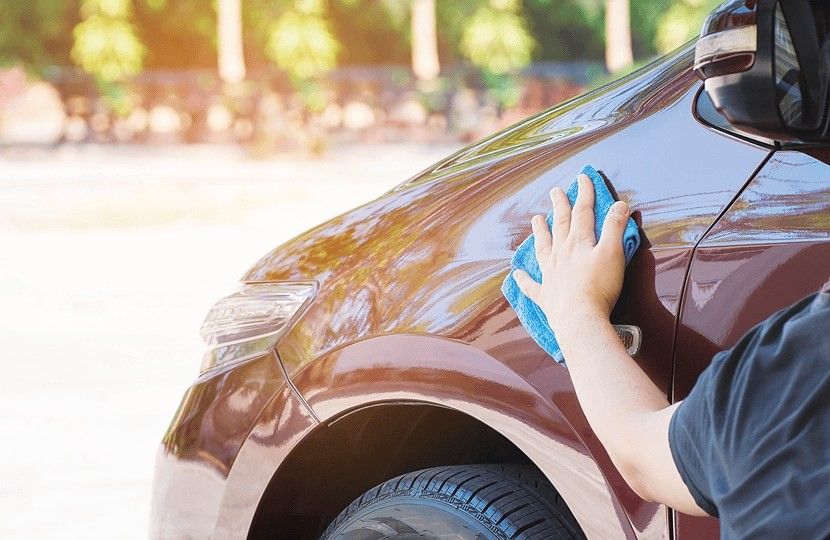
If you live in a desert climate like Dubai, you know the cycle: you wash your car in the morning, and by the afternoon, a fine layer of beige dust has already settled on the hood. In the world of car detailing, we often talk about “protection,” but the real battle against the desert isn’t just about a hard shield—it’s about the physics of slickness.
While traditional waxes feel “oily,” a professional-grade car paint protection coating uses molecular engineering to change how your car interacts with the environment. It’s the difference between a surface that “holds” dust and one that actively “sheds” it.
The Molecular Villain: Van der Waals Forces
To understand how to fight dust, you first have to understand why it sticks. At a microscopic level, dust doesn’t just “fall” on your car; it is pulled toward it by Van der Waals forces. These are weak electromagnetic attractions that occur between molecules.
On a standard, unprotected clear coat, the surface is full of microscopic pores and jagged “valleys.” This creates more surface area for dust particles to grab onto. Once a dust particle settles into one of these microscopic pits, the Van der Waals forces lock it in place. This is why you can’t simply “blow” dust off a dirty car—it’s literally glued there at a molecular level.
The Coating Solution: Surface Energy and Slickness
This is where advanced car paintwork protection comes in. A high-quality nano-ceramic coating is engineered to have extremely low surface energy.
- Filling the Pores: The coating’s nano-particles are so small that they flow into the microscopic pores of your clear coat, leveling the surface until it is surgically flat.
- Reducing Friction: This creates a “slickness” (a low coefficient of friction) that is physically impossible for a factory finish to achieve.
- Breaking the Bond: Because the surface is now perfectly flat and chemically inert, the Van der Waals forces are significantly weakened. There are no “valleys” for the dust to settle into, and the low surface energy means there is almost zero “grip” for the particles.
The “Self-Cleaning” Effect in a Sandstorm
In the UAE, sandstorms are the ultimate stress test. A “slick” car has a massive advantage during these events.
- The Airflow Release: When you drive a coated car, the airflow moving over the body panels is often enough to dislodge loose dust. Because the surface energy is so low, the wind can actually overcome the weak molecular bond of the dust.
- Hydrophobic Assistance: When it does rain (or when you do a quick rinse), the coating’s hydrophobic nature causes water to bead into perfect spheres. As these beads roll off the car, they act like miniature vacuum cleaners, picking up the unattached dust particles and carrying them away.
Why “Slick” is Safer Than “Hard”
Many people focus on the “9H Hardness” of a coating, but in a desert, slickness is actually more important for your paint’s health. If dust can’t stick, you don’t have to wipe the car as often.
Frequent wiping of a dusty car—even with a microfiber—is the #1 cause of swirl marks. By choosing a coating with a high slickness factor, you are reducing the amount of physical contact needed to keep the car clean, which is the best form of car paint protection you can give your vehicle.


Get In Touch
Stay Connected For Ultimate Car Care
 sales@rmappf.ae