

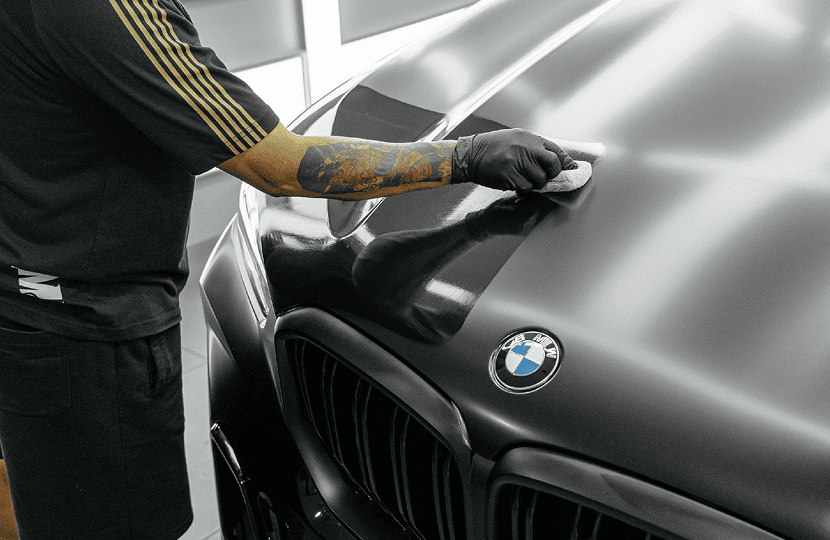
Whether it’s Mercedes-Benz’s Designo Magno or BMW’s Frozen series, factory matte finishes are among the most striking options on the road today. However, they represent a unique challenge in the world of car detailing.
Unlike traditional clear coats, which are smooth and reflective, matte and satin finishes are microscopically “rough.” These peaks and valleys scatter light instead of reflecting it, creating that signature flat look. If you fill in those valleys with wax or level those peaks with polish, you end up with a blotchy, permanent shine.
Here is the definitive guide to professional car detailing for matte finishes without adding a hint of gloss.
1. The Golden Rule: Never Polish or Buff
In standard car detailing, polishing is the secret to a mirror-like shine. For a Magno or Frozen finish, polishing is the enemy.
- The Danger: Even light hand-polishing acts as an abrasive that levels the paint’s texture.
- The Result: Once you create a “shiny spot” on matte paint, it cannot be reversed. The only fix is a total respray of the panel.
- The Protocol: Hide the dual-action polisher and the rubbing compounds. Your goal is decontamination, not correction.
2. Chemical Decontamination Over Mechanical
Because you can’t use a traditional clay bar (which can leave glossy “marring” streaks), your car detailing arsenal must rely on chemistry.
- Iron Removers: Use a pH-neutral iron fallout remover to dissolve brake dust and metallic particles.
- Tar & Sap: Use a dedicated matte-safe solvent. Apply it to a microfiber towel and let it dwell on the spot rather than scrubbing aggressively.
- Matte-Specific Soap: Ensure your shampoo contains zero gloss enhancers, waxes, or silicones. Look for “Pure” soaps that leave nothing behind but a clean surface.
3. The Two-Bucket Wash Method
Matte paint is surprisingly delicate. While a scratch on a gloss car can be buffed out, a scratch on a Frozen finish is permanent.
- Pre-Wash: Use a heavy layer of snow foam to lift dirt away from the surface.
- The Wash: Use the two-bucket method with a high-quality grit guard.
- The Touch: Use a dedicated microfiber wash mitt and move in straight lines—never circular motions—to minimize the risk of swirl marks.
4. Drying Without Friction
Friction creates heat, and heat can lead to burnishing (unwanted shine).
- Air Drying: The safest way to dry a matte car is with filtered, forced air. Use a leaf blower or a dedicated car dryer to whisk water out of the crevices.
- Drying Towels: If you must use a towel, use a large, high-GSM twisted loop microfiber. Pat the car dry rather than dragging the towel across the surface.
5. Protection: Matte-Specific Ceramic Coatings
Traditional waxes are designed to fill pores and create a “wet look,” which is exactly what you don’t want. Modern car detailing technology has provided a better solution: Matte Ceramic Coatings.
- The Benefit: These coatings provide a microscopic barrier against UV rays, bird droppings, and water spots without changing the light-scattering properties of the paint.
- The Finish: A proper matte coating will actually deepen the color of a Magno finish, making it look “richer” rather than “shinier.”
- Ease of Use: This makes future car detailing sessions much easier, as dirt cannot bond to the textured surface as easily.
6. Emergency Maintenance: The Matte Quick Detailer
Fingerprints are the bane of matte paint; the natural oils from your skin can create shiny spots on door handles and trunk lids. Always keep a bottle of Matte Quick Detailer and a fresh microfiber in your trunk. These sprays are formulated to evaporate quickly and remove oils without leaving behind a “wax” residue.
Final Pro Tip:
When performing car detailing on a Magno or Frozen finish, always test new products on an inconspicuous area, such as the lower part of the side skirt or inside the door jamb. This ensures the product won’t alter the finish before you commit to the entire hood.

Get In Touch
Stay Connected For Ultimate Car Care
 sales@rmappf.ae