

In the high-voltage world of Electric Vehicles (EVs), efficiency is the ultimate currency. If you are driving a Tesla Model 3 with its expansive glass canopy or a Porsche Taycan in the middle of a Dubai July, you aren’t just fighting the heat—you are fighting for your range.
While most owners view window tinting as a stylistic or comfort upgrade, for an EV, it is a legitimate hardware optimization. Here is the science of how a premium ceramic film can actually protect your battery’s health and extend your kilometers per charge.
The “AC Drain” Reality
In a traditional internal combustion engine (ICE) car, the air conditioning system is powered by the engine’s belt or an alternator, often using “waste” energy. In a Tesla or any EV, every frigid gust of air coming out of your vents is pulled directly from the same high-voltage battery that moves your wheels.
When your cabin hits 60°C after sitting in the sun at Dubai Design District, your thermal management system goes into “overdrive.” To drop that temperature to a comfortable 22°C, the car’s resistive heaters or heat pumps consume massive amounts of kilowatts. By installing high-rejection window tinting, you reduce the “thermal load” on the cabin, meaning the AC can maintain your desired temperature using significantly less energy.
1. Extending “Wh/km” Efficiency
The more heat your glass lets in, the harder your cooling fans and compressors work. Data from EV enthusiasts has shown that on a 40°C day, a Tesla with premium ceramic window tinting can see a measurable improvement in Watt-hours per kilometer (Wh/km).
- Without Tint: The AC may struggle constantly, eating 10–15% of your total range.
- With Ceramic Tint: The cabin stays insulated, allowing the AC to “cycle” lower, potentially saving 3–5% of your battery capacity on long highway hauls.
2. Reducing “Cabin Overheat Protection” Cycles
Tesla’s “Cabin Overheat Protection” is a brilliant safety feature, but it is a silent battery killer. When enabled, the car wakes itself up to vent or cool the interior whenever it hits a certain threshold (usually 40°C). In the UAE, an untinted car hit this threshold every 20 minutes. This constant “wake-sleep” cycle causes “vampire drain”—the loss of percentage points while the car is parked. A high-index ceramic window tinting solution keeps the interior below that trigger point for much longer, preserving your state of charge for when you actually need to drive.
3. Protecting the “Mainframe” (The MCU)
EVs are essentially rolling supercomputers. The massive center touchscreens (Media Control Units) in Teslas and Lucid Airs are sensitive to extreme thermal radiation. Constant “baking” of the dashboard doesn’t just age the vegan leather; it stresses the processors and adhesives behind the screen. By blocking 99% of UV and a massive portion of Infrared (IR) heat, your window tinting acts as a thermal shield for the most expensive electronics in your vehicle, potentially preventing long-term hardware failure.
4. Why “Ceramic” is the Only Choice for EVs
If you take your EV to a budget shop that uses metallic or “hybrid” films, you might regret it. Metallic tints act as a signal shield. In a car that relies on constant 4G/5G connectivity for Autopilot updates, GPS, and Spotify, a metallic film can cause “signal hunting.” When your car struggles to find a signal, it boosts its internal antennae power, which—you guessed it—drains even more battery. Nano-ceramic window tinting is 100% non-conductive, ensuring your tech stays connected without the extra power draw.
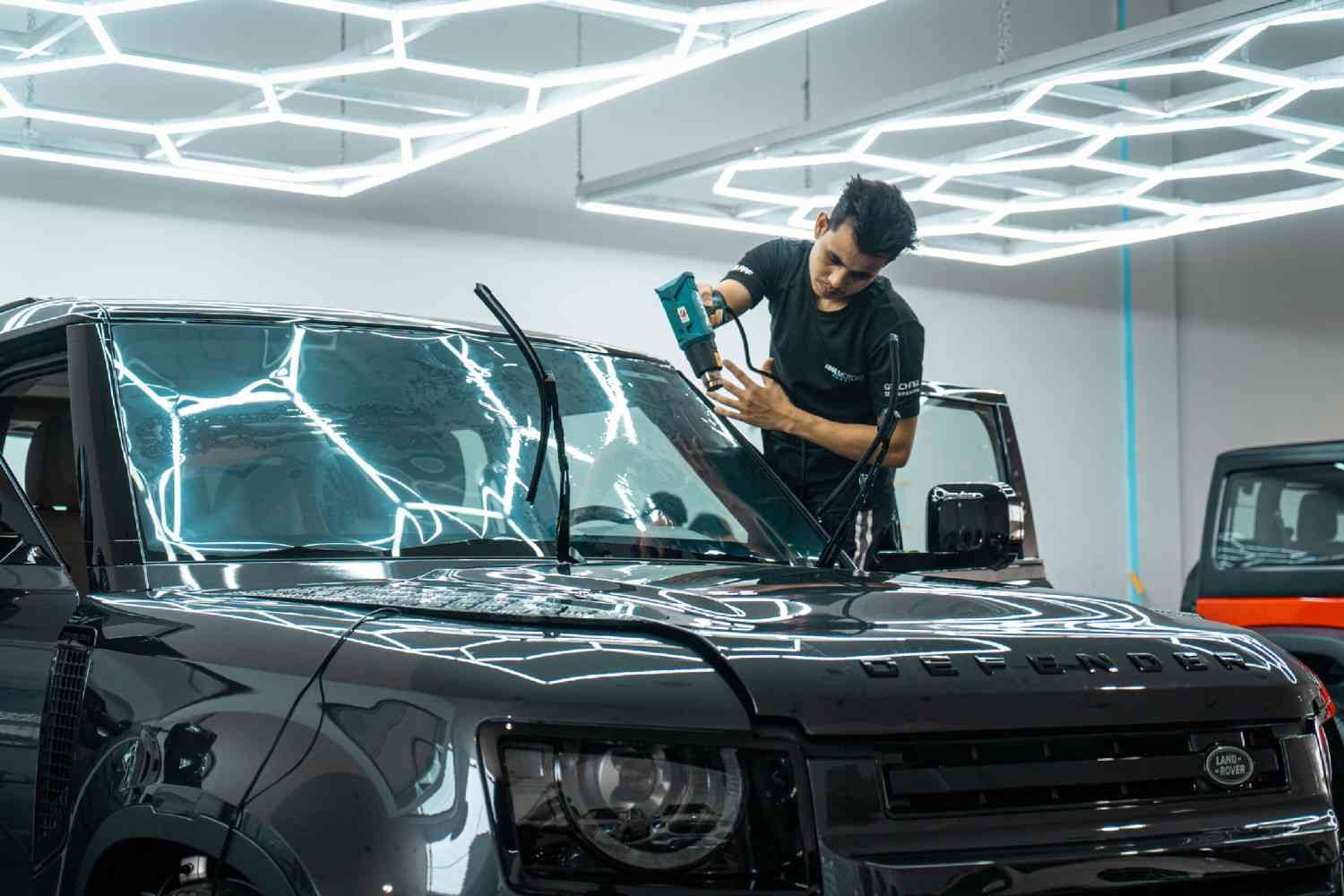
The EV Owner’s Tip: Don’t forget the windshield. Because it is the largest piece of glass and sits at an angle that catches the most direct sun, a “clear” ceramic tint on the front windshield is often more effective for battery savings than tinting all the side windows combined.

Get In Touch
Stay Connected For Ultimate Car Care
 sales@rmappf.ae