

You just picked up a brand-new Nissan Patrol, Range Rover, or BMW X7. You noticed the rear windows are already dark—a deep, charcoal shade that looks perfectly finished. The salesperson told you it has “factory tint,” so you assume your passengers are protected from the Dubai sun.
Here is the cold, hard truth: Those windows are lying to you.
In the world of window tint, there is a massive difference between Privacy Glass and Solar Protection Film. If you rely solely on the factory “darkness,” you are essentially sitting in a high-end greenhouse. Here is why.
1. It’s Pigment, Not Protection
“Privacy Glass” is created by adding a dark pigment directly into the glass during the manufacturing process. Its primary purpose is exactly what the name suggests: privacy. It makes it harder for people to see your cargo or your passengers.
However, standard factory privacy glass has almost zero Infrared (IR) rejection properties. While it blocks visible light (making the cabin look darker), it allows the sun’s thermal energy to pass right through. This is why your kids are still sweating in the back seat even though the windows look “blacked out.”
2. The “Heat Trap” Effect
Dark colors absorb heat. Because factory privacy glass is dark but lacks ceramic heat-rejection technology, the glass itself actually gets hotter than clear glass. It absorbs the sun’s energy and then radiates that heat directly into the cabin.
Without a professional window tinting layer to reflect that energy away, your SUV’s rear section becomes a thermal reservoir, forcing your AC system to work twice as hard to cool the larger interior volume of a 7-seater.
3. The Invisible Danger: UV Rays
Most factory glass—even the dark stuff—only provides partial protection against UV rays. While it might block UVB (the rays that cause sunburn), it often lets in significant amounts of UVA (the rays that cause skin aging and long-term DNA damage).
When you apply a high-index ceramic window tinting over privacy glass, you add a definitive 99% UV barrier. This protects your family’s skin and prevents your expensive leather or Alcantara upholstery from fading and cracking over time.
4. The Optical Clarity Gap
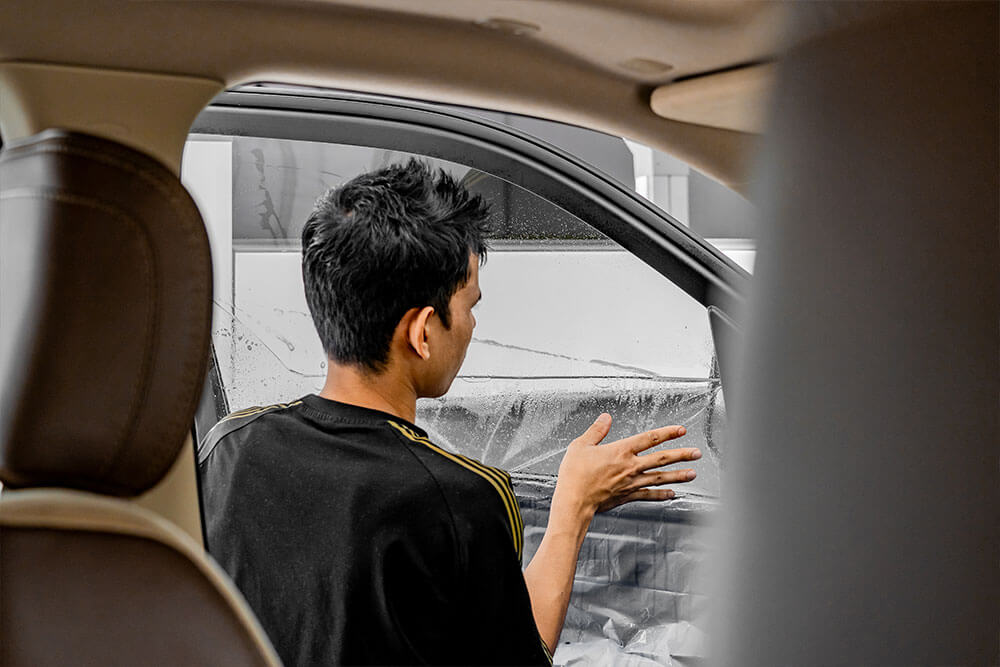
Cheap factory glass can sometimes have slight distortions when viewed at an angle. High-end ceramic films are engineered for optical “high-definition.” By adding a premium film, you actually improve the structural integrity of the window (shatter resistance) and provide a crisper view of the Dubai skyline for your passengers, even at night.
The Solution: The “Clear” Over-Layer
You don’t have to make your windows even darker to get protection. Many SUV owners choose a 70% VLT (virtually clear) ceramic film to install over the factory privacy glass.
- The Result: The “look” of your SUV remains exactly as the manufacturer intended.
- The Benefit: You instantly gain 90%+ Infrared Rejection and 99% UV protection.
The UAE SUV Tip: Because SUVs have so much glass surface area, the “Heat Gain” is significantly higher than in a sedan. Tinting the rear glass is important, but don’t forget the sunroof. That horizontal piece of glass is the primary entry point for the mid-day sun.

Get In Touch
Stay Connected For Ultimate Car Care
 sales@rmappf.ae