

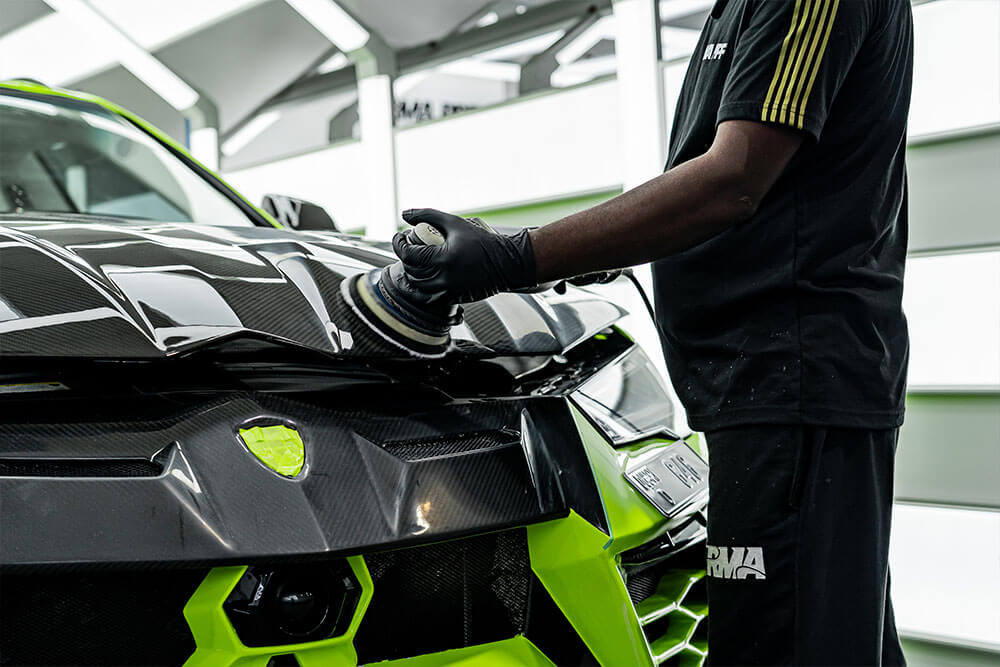
If you had walked into a workshop five years ago, “protection” meant a thick, somewhat noticeable film that hopefully stopped a rock chip. But it’s 2026 now, and the game has fundamentally changed. The “Invisible Shield” is no longer a marketing slogan—it’s a scientific reality.
As a petrolhead who spends more time in studios than at home, I’ve seen the “nitty-gritty” of these new technologies. If you’re looking to protect a new acquisition this year, here are the 2026 trends that are currently redefining the Dubai roads.
1. Instant Self-Healing 2.0 (No Heat Required)
For years, we told owners that their paint protection film (PPF) would heal if they left it in the afternoon Dubai sun. In 2026, we’ve moved past that. The latest generation of elastomers in premium car PPF now features “Instant Recovery.”
These films possess a higher molecular memory. When a light scratch occurs—whether from a dusty car wash or a stray shopping bag—the polymer chains reconnect almost instantly at room temperature. You no longer have to wait for a 40°C day to see the magic happen; the film is actively working every second you’re on the road.
2. The Total Convergence of Color and Protection
The biggest shift in 2026 is the death of the traditional vinyl wrap. Enthusiasts have realized that vinyl is too thin for the UAE’s harsh climate. Enter Color PPF.
Brands like Profilm have perfected films that offer the exact depth, metallic flake, and “orange-peel-free” finish of a factory respray, but with the 200-micron thickness of a protective shield. In 2026, the “Frozen” look or “Liquid Metallic” finish isn’t achieved in a paint booth; it’s achieved in a clean room with a precision-engineered film.
3. AI-Driven Pattern Precision
Human error is becoming a thing of the past. In 2026, the best studios aren’t just using standard templates; they are using AI-enhanced 3D scanning.
Before the film even touches your car, the studio creates a digital twin of your specific vehicle. This allows for “Micro-Edge Wrapping,” where the film is tucked behind sensors, lights, and trim pieces with a level of accuracy that was impossible just a few years ago. This ensures that even on complex 2026 EV designs with intricate aero-ducts, the PPF in Dubai is truly invisible.
4. Graphene-Infused Top Coats
While ceramic coatings are still excellent, 2026 is the year of the “Nano-Hybrid.” We are now seeing paint protection film that comes pre-infused with graphene at a molecular level.
Why does this matter for Dubai drivers? Graphene is highly conductive, which reduces the static charge on your car’s surface. This means that fine desert dust—the kind that usually clings to your car the moment you leave the garage—simply slides off. It stays cleaner for longer, and the “slickness” to the touch is unlike anything we’ve felt before.
Why the “Enthusiast” Approach Matters More Than Ever
With tech this advanced, the “who” is more important than the “what.” You can have the most expensive 2026-spec film, but if it’s installed by someone who doesn’t understand the nitty-gritty of thermal expansion or panel tension, it will fail.
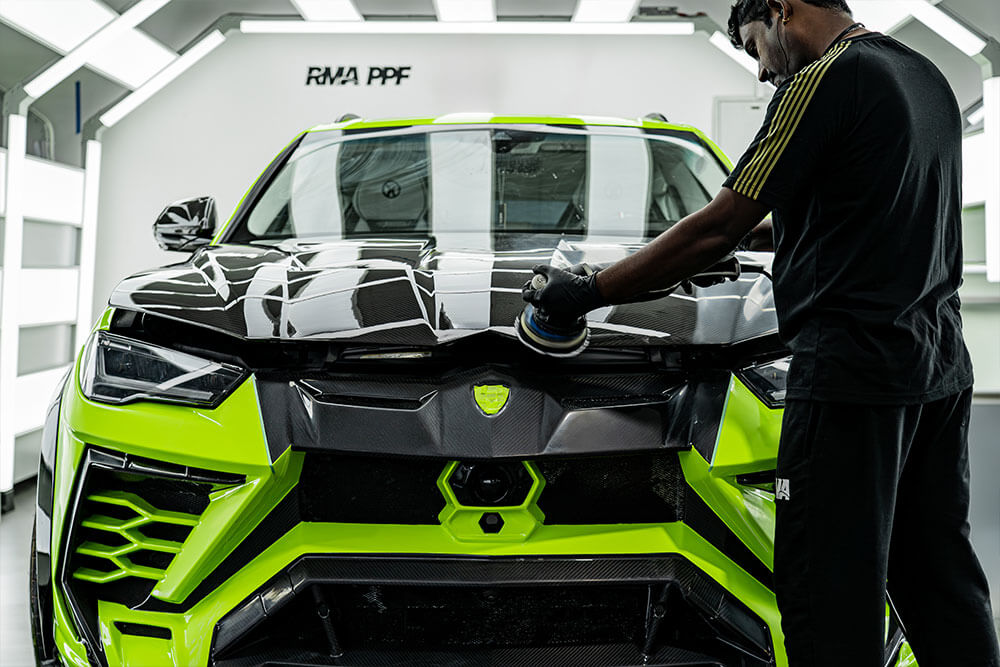
I’ve always gravitated toward RMA PPF for this exact reason. The studio is built by car enthusiasts who don’t just see body panels; they see the engineering behind the machine. They are petrolheads who understand the “nitty-gritty” of how a car’s surface reacts to the 50°C heat and high-speed sand abrasion of the E11.
They don’t just follow a manual; they experiment to find what works best for the unique conditions of the Middle East. Their reputation for excellence is a direct result of this obsession. They aren’t just “installers”—they are guardians of automotive value.
The Verdict
The future of car care is about high-tech materials and surgical precision. In 2026, protecting your car isn’t about adding a layer; it’s about upgrading the surface itself.

Get In Touch
Stay Connected For Ultimate Car Care
 sales@rmappf.ae