

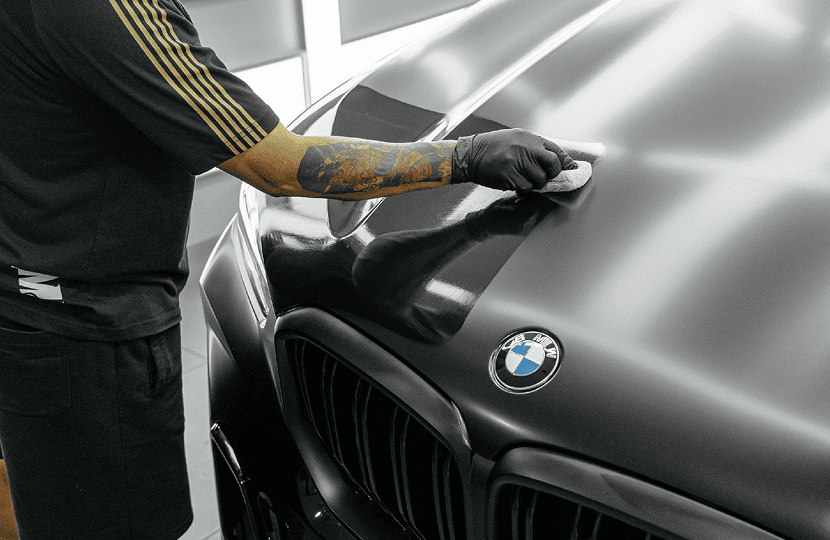
We’ve all been there. You spend a Saturday afternoon in the driveway, elbow grease hitting the door panels, applying a high-end carnauba wax. When you’re done, the car looks “shiny.” You’re proud. But then, Monday morning rolls around, you catch your car under the harsh, unforgiving Dubai sun, and—there they are. The swirl marks. The spider webs. That weird, hazy “film” that makes your deep black paint look slightly grey.
This is the great heartbreak of the “Standard Wax.” Today, we’re pulling back the curtain on why that wax job is just a temporary mask and why machine leveling is the secret to a gloss so deep it looks like you could reach your hand into the paint.
The Waxing Illusion: Putting a Band-Aid on a Crater
To understand why waxing often fails the “sunlight test,” we have to look at your paint under a microscope.
Your car’s clear coat isn’t perfectly flat. Over time, it develops millions of microscopic “peaks” and “valleys” caused by dust, improper washing, and road grit. When light hits these jagged valleys, it bounces off in a thousand different directions. This is called diffuse reflection, and to your eyes, it looks like dullness or swirl marks.
When you perform car detailing, applying wax is essentially filling those valleys with a temporary clear “filler.” For a few days, the surface looks smoother, and the light reflects better. But wax is soft. It melts in the UAE heat, washes off with a few rains, and eventually evaporates, revealing the same ugly “craters” underneath. It offers very little in the way of true car paintwork protection.
Machine Leveling: The Molecular Level-Up
Professional machine leveling (often called paint correction) is a completely different animal. We aren’t hiding the valleys; we are removing the peaks. It is a fundamental part of high-end car detailing that provides the ultimate foundation for car paint protection.
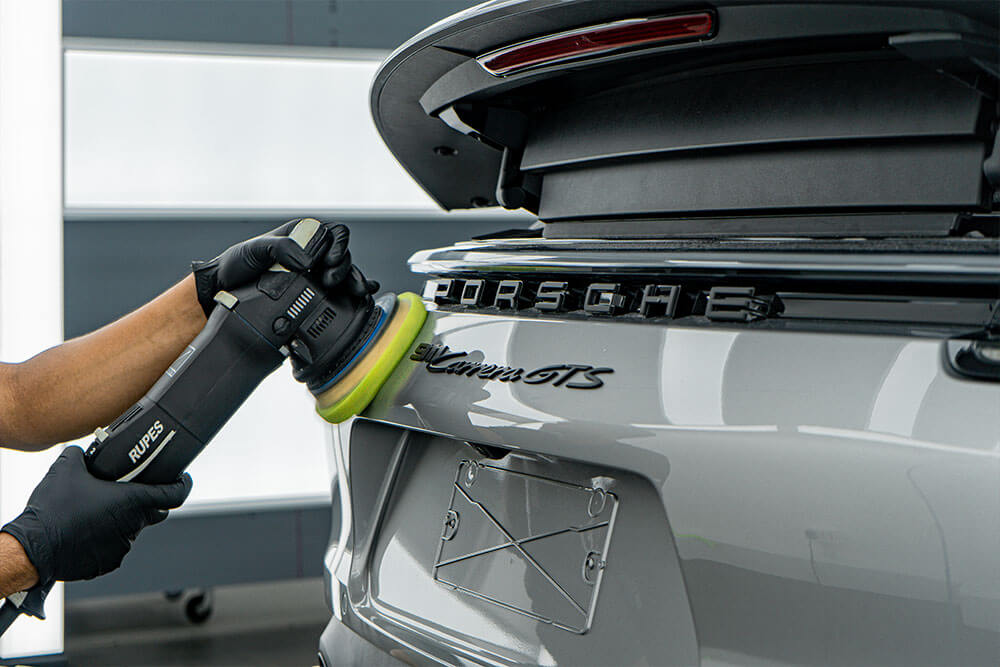
Using a dual-action polisher and specialized abrasive compounds, a detailer meticulously “shaves” down the microscopic top layer of the clear coat—usually only a few microns thick—until it is perfectly level with the bottom of the scratches.
- Uniform Reflection: Once the surface is perfectly flat, light doesn’t scatter. It hits the surface and bounces back in a straight line. This is specular reflection, and it is the technical reason behind that “wet look” gloss.
- Permanent Clarity: Because you’ve physically leveled the paint, the shine doesn’t “wash off.” The gloss is now a permanent characteristic of the clear coat itself, restoring the car paintwork protection to its factory-fresh clarity.
- The Foundation for Protection: If you apply PPF or a ceramic coating over leveled paint, the results are magnified. It’s like putting a glass screen protector on a brand-new iPhone vs. one that’s already cracked.
Why the “Overload” Matters
“Gloss Overload” happens when the paint is so level that the refractive index of the clear coat is maximized. The color looks richer, the metallic flakes in the paint “pop” with more intensity, and the car takes on a mirror-like quality that is impossible to achieve with a hand-applied wax.
In a city like Dubai, where luxury cars are the standard, the difference between a “waxed” car and a “leveled” car is the difference between looking clean and looking elite.
Stop masking the problem with temporary oils. If you want a finish that stops traffic and offers real car paint protection, it’s time to move past the tin of wax and embrace the science of the machine.


Get In Touch
Stay Connected For Ultimate Car Care
 sales@rmappf.ae