

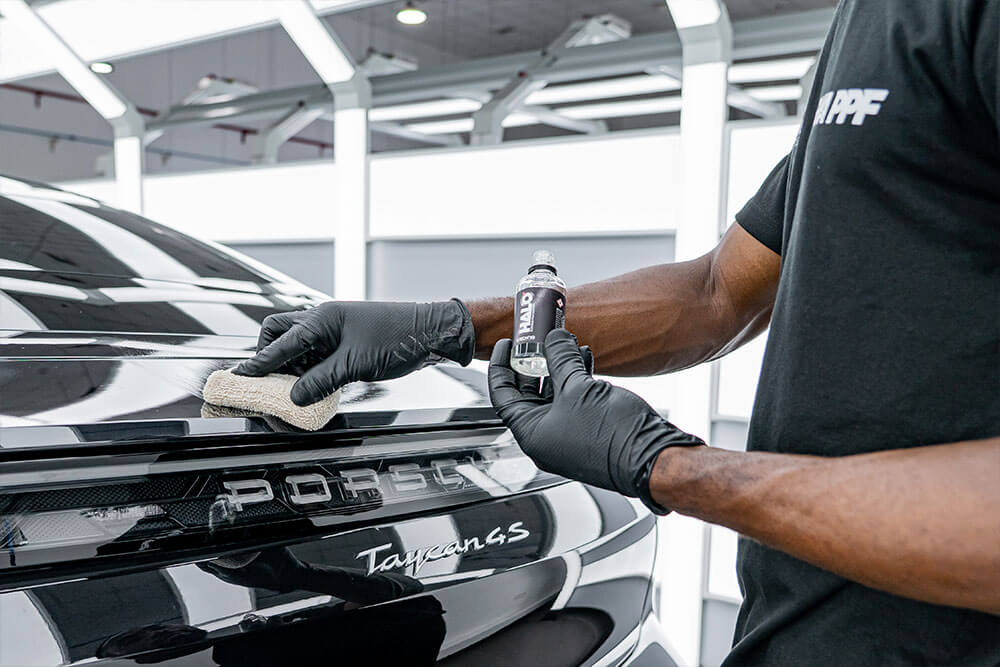
When you take delivery of a brand-new luxury vehicle, the paint looks “shiny.” To the untrained eye, it is perfect. But to a master of car detailing, that factory finish is often hiding its true potential behind a microscopic landscape of peaks and valleys known as “orange peel.”
If you’ve ever looked at a reflection in your car door and noticed the edges of the reflection look fuzzy or blurred, you are seeing the limitations of mass-production painting. To achieve a true, world-class mirror finish, you need more than just polish—you need Texture Leveling.
The Anatomy of the “Orange Peel” Problem
Even the most advanced robotic painting arms in modern factories cannot achieve a perfectly flat surface. As the clear coat dries, surface tension and solvent evaporation cause the paint to settle into a wavy pattern that resembles the skin of an orange.
In the world of professional car detailing, this texture is the enemy of “Depth.”
- Scattered Light: Instead of bouncing directly back to your eye, light hits these “waves” and scatters in different directions.
- Muted Color: The uneven surface prevents you from seeing the true richness of the pigment or the metallic flake beneath the clear coat.
- Blurred Reflections: Objects reflected in the paint appear distorted, robbing the car of that “liquid” look.
What is Texture Leveling?
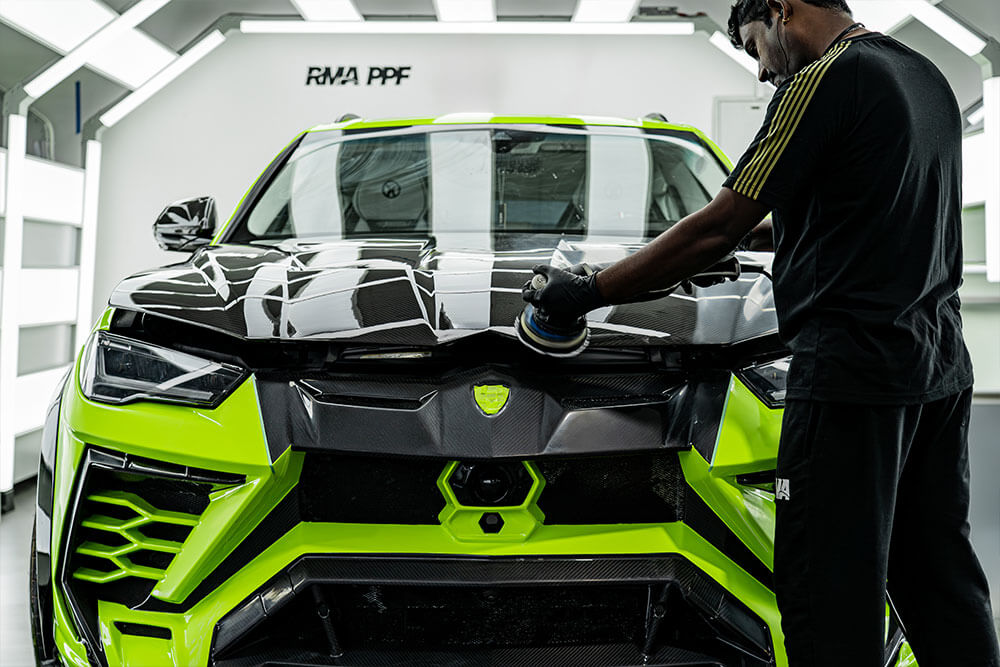
Texture leveling is an advanced stage of car detailing that goes far beyond standard paint correction. While a typical “cut and polish” removes scratches and swirls, texture leveling aims to physically flatten the clear coat itself.
This is usually achieved through Wet Sanding (also known as color sanding). By using ultra-fine abrasives (3000 to 5000 grit) and specialized leveling blocks, a detailer carefully shaves down the high points of the orange peel until the surface is as flat as a sheet of glass.
Why “Shiny” Isn’t Enough: The Science of Depth
In high-end car detailing, we distinguish between gloss and optical clarity.
- Gloss: A measure of how much light is reflected. Even a wavy surface can be high-gloss.
- Optical Clarity: The sharpness of the reflected image. This is only possible when the surface is level.
When you level the texture, you eliminate the “diffraction” of light. The result is a finish so deep it looks like you could reach your hand into the paint. This is what separates a “detailed” car from a “Concours d’Elegance” winner.
The Risks: Why This is Only for Professionals
Texture leveling is the “open-heart surgery” of car detailing. Because you are physically removing a measurable percentage of the clear coat to flatten it, there is zero room for error.
- Paint Thickness Gauges: A professional must measure the micron levels of the paint before starting to ensure there is enough clear coat to safely level.
- Heat Management: Aggressive leveling requires careful heat monitoring to prevent burning through to the base color.
- The Refinement Stage: After leveling, the paint is “dull.” It requires a multi-stage machine polish to bring back the shine and achieve that legendary mirror finish.
Is Your Car a Candidate?
Not every vehicle needs or should undergo texture leveling. However, it is the ultimate upgrade for:
- Show Cars: Where every reflection must be tack-sharp.
- Custom Paint Jobs: Where the depth of the color is the primary focus.
- High-Value Collections: Where the owner wants a finish that surpasses the factory standard.
Conclusion: The Ultimate Evolution of Car Detailing
Standard car detailing makes a car look “new.” Texture leveling makes a car look “unreal.” By removing the industrial artifacts of the factory painting process, we unlock the true optical potential of the clear coat.
If you are tired of “fuzzy” reflections and want a finish that looks like poured liquid glass, it’s time to look past the shine and start talking about texture.

Get In Touch
Stay Connected For Ultimate Car Care
 sales@rmappf.ae