

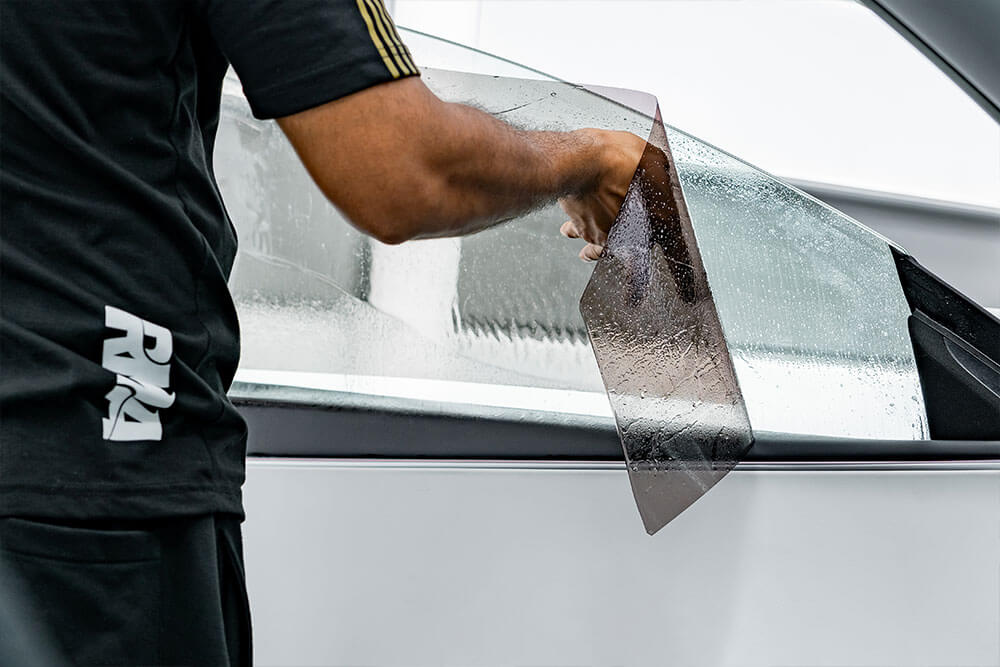
When choosing window tinting for your vehicle, the priority is always thermal rejection—blocking the sun’s brutal heat. But in a modern vehicle, connectivity is just as vital as comfort. You rely on your car’s navigation, satellite radio, and strong mobile signal for daily life.
What many drivers don’t realize is that the wrong kind of tint—specifically, older metallic films—can effectively turn your car into a signal-blocking cage, rendering your GPS useless and leading to dropped calls. Here’s a breakdown of the problem and why switching to non-metallic technology is crucial for modern connectivity.
The Problem: The Faraday Effect
Older, high-performance window tinting often achieved its heat-rejecting properties by incorporating tiny metal particles into the film. These metallic films work exceptionally well to reflect solar energy, but they create a significant unintended consequence known as the Faraday Effect.
- Signal Disruption: Metal is an electrical conductor. When a continuous layer of metal film is applied across your windows, it acts as a barrier, shielding the interior from external electromagnetic waves—including radio, GPS, and cell signals.
- Real-World Failures: This results in frustrating issues: your navigation system loses accuracy, your satellite radio cuts out, and your keyless entry fob sometimes fails to connect until you’re right next to the door.
For vehicles packed with modern tech, including vital Advanced Driver Assistance Systems (ADAS) that rely on radar, metallic tint is a critical compromise.
The Solution: Non-Metallic Ceramic Technology
The development of nano-ceramic window tinting completely solved this issue. These films are engineered to achieve superior thermal performance without using a single piece of metal.
- Molecular Efficiency: Nano-ceramic films are infused with tiny, non-conductive ceramic particles. These particles are spectrally selective, meaning they are designed to target and block Infrared (IR) heat rays and UV radiation, without blocking the electromagnetic frequencies used by communication devices.
- Flawless Connectivity: Because the film is non-metallic, it does not interfere with any signals. Your GPS remains accurate, your mobile calls stay connected, and your radio reception is crystal clear.
- Future-Proofing: This non-metallic approach is essential for future-proofing your car. As vehicles become more reliant on cellular data for diagnostics, updates, and navigation, choosing a signal-friendly film ensures your car’s complex electronics function as designed.
Why Quality Matters for Your Car Protection Film
Choosing a quality, non-metallic film is an investment in both comfort and utility. You should never have to choose between a cool cabin and a functioning phone.
By selecting advanced ceramic technology, you are getting the ultimate window tinting solution: maximum heat rejection and UV defense, coupled with guaranteed signal clarity for all your critical devices.


Get In Touch
Stay Connected For Ultimate Car Care
 sales@rmappf.ae