

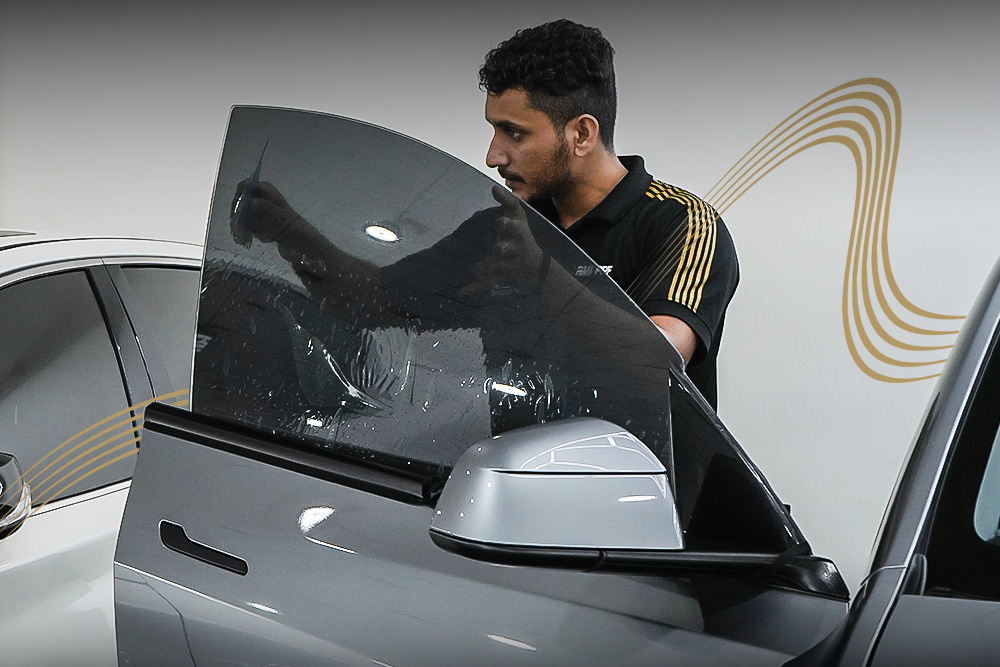
When you invest in PPF (Paint Protection Film), you are purchasing a specific level of defense, usually measured by its thickness. The industry standard for robust protection is often around 8-mil (eight thousandths of an inch). This thickness is non-negotiable; it’s what gives the film the density required to absorb the impact of rock chips and resist deep scratches.
However, even the highest quality PPF—like Profilm—can have its protective integrity compromised by a common installation flaw: overstretching. This hidden risk is invisible to the naked eye but drastically weakens the film’s crucial defense layer. This is why choosing an installer with technical expertise is the final check against a faulty job.
The Science of Dilution: Why 8-Mil Matters
The 8-mil measurement is the scientific guarantee of the film’s strength. It ensures that the elastic, energy-absorbing TPU (Thermoplastic Polyurethane) substrate is thick enough to cushion and disperse the force of a high-speed projectile.
When a technician overstretches the film during installation, the material is pulled thinner and thinner, often dropping the density in the stretched zone from 8-mil down to 6-mil or even 5-mil.
- Compromised Defense: This drastic reduction in thickness means the film loses its structural integrity. The area is now far more likely to be pierced by a rock chip or easily torn by a key scratch.
- Reduced Self-Healing: The elastomeric polymer responsible for the self-healing function is thinned out, reducing its ability to “remember” its original shape. Scratches in that area will heal slowly, poorly, or not at all.
For a car protection film to perform its job, its uniform thickness must be preserved across every square inch of the vehicle.
The Overstretching Danger Zone
Overstretching often occurs when installers attempt to save material or use manual, hand-cut methods to force the film to conform to a complex shape. The danger zones are:
- Complex Corners: Deep recessed areas, sharp edges, and the aggressive curves of bumpers and mirror housings. Amateurs will try to pull a flat piece of film over these curves rather than using proper shrinking techniques.
- Hood Edges: Trying to stretch one single piece of film to cover a long, sweeping panel without the help of ProCut precision templates leads to overstretching near the edges.
The RMA PPF Solution: Precision Over Production
At RMA PPF, we mitigate the risk of overstretching by relying on technology and attention to detail:
- ProCut Software: We use Profilm’s advanced 3D cutting software to create templates that fit the exact complex dimensions of the panel. This eliminates the need for installers to forcefully stretch the film over large, multi-directional curves.
- Thermal Shrinking Mastery: Our certified technicians use controlled heat shrinking (thermal molding) to relax the film and gently conform it to the vehicle’s curves, rather than stretching the TPU substrate manually. This maintains the film’s structural integrity and ensures that 8-mil protection remains consistent across the panel.
- Material Allocation: We prioritize using the appropriate size of film, never attempting to squeeze a smaller piece over a large panel just to save material. Our primary concern is the longevity and structural protection & value delivered to your PPF car.
By choosing a professional installation guided by technology, you ensure that the high-quality paint protection film you paid for retains its full 8-mil strength, providing genuine, reliable defense for your vehicle.


Get In Touch
Stay Connected For Ultimate Car Care
 sales@rmappf.ae