

Imagine walking into a tailor and being told that every suit in the shop—regardless of whether it’s made of delicate silk or heavy wool—is ironed with the exact same high-heat setting. You’d walk out immediately, right? You’d know instinctively that the silk would scorch while the wool wouldn’t even lose its wrinkles.
In the world of car detailing, many owners assume that “polishing is polishing.” But professional detailers live by a different law: The Paint Hardness Rule.
The clear coat on a Tesla is fundamentally different from the clear coat on a Ferrari or a BMW. Understanding the “hardness” of your specific car’s paint is the difference between a flawless mirror finish and a detailing disaster.
The Mohs Scale of Automotive Paint
Every car manufacturer uses a specific chemical “recipe” for their clear coat. Some are designed to be “soft” (easy to polish but easy to scratch), while others are “hard” (difficult to scratch but incredibly stubborn to fix).
In car detailing, we measure this resistance on a relative scale of hardness.
- Soft Paint (The “Sticky” Challenge): Common on many Japanese brands and famously on Teslas. Soft paint is a nightmare because it “marrs” if you even look at it wrong. If a detailer uses a pad that’s too aggressive, they’ll actually create more scratches while trying to remove old ones.
- Hard Paint (The “Ceramic” Clear): Common on German titans like Audi, VW, and Mercedes-Benz. These clear coats are often infused with ceramic particles. They are great for car paint protection against daily wear, but once they do get scratched, they require massive amounts of heat and aggressive heavy-cutting compounds to level out.
Why the “Test Spot” is Non-Negotiable
A “hacksaw” approach to detailing leads to thin clear coats and “burnt” edges. This is why we never start a full car detailing session without a Test Spot.
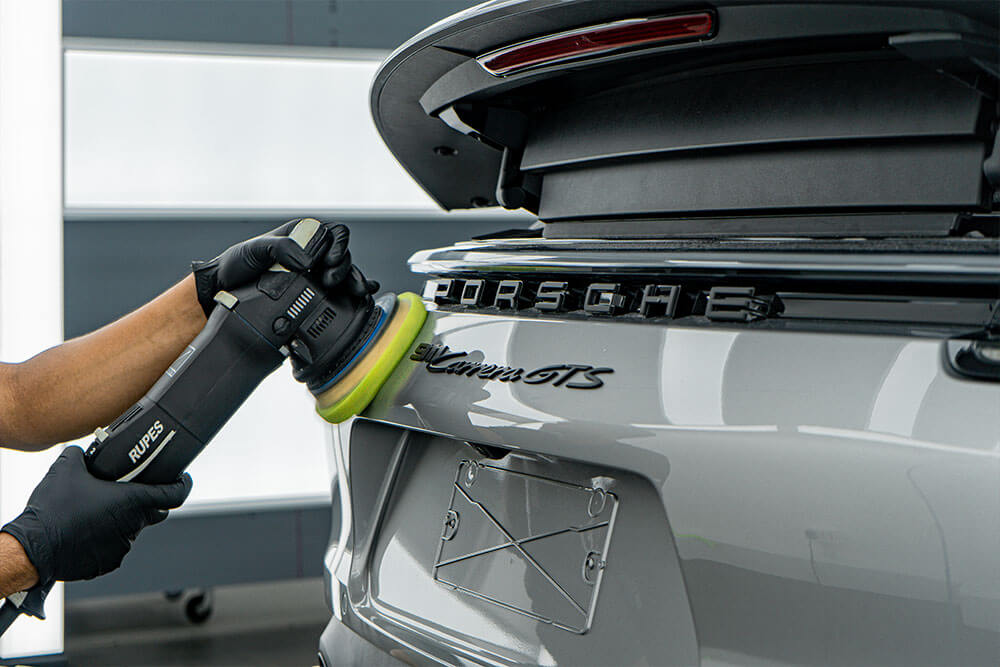
We choose a small, inconspicuous area and start with the least aggressive combination of pad and polish.
- The Reaction: Does the paint “clear up” quickly? It’s soft.
- The Resistance: Does the polish just sit there with no change to the swirls? It’s hard.
- The Solution: Based on this, we “recipe” a custom plan. For a Lamborghini, we might use a microfiber cutting pad; for a soft-paint Lexus, we might stick to a fine finishing foam.
The Link to Car Paint Protection
Why does this matter to you? Because the hardness of your paint dictates your car paintwork protection strategy.
- For Soft Paint: If your car has soft paint, PPF (Paint Protection Film) is almost mandatory. Since the paint is so vulnerable to light wiping, a self-healing film acts as the “hard” shell the factory didn’t provide.
- For Hard Paint: While tougher, hard paint can become brittle. A high-quality ceramic coating adds a layer of “slickness” that prevents debris from catching on that hard surface, keeping the gloss locked in.
Don’t Settle for “Universal” Detailing
A professional detailer is part chemist, part artist. They understand that a black Porsche requires a totally different pressure, speed, and chemical load than a black Toyota. By respecting the Paint Hardness Rule, we ensure that we remove the defects while preserving as much of your precious factory clear coat as possible.


Get In Touch
Stay Connected For Ultimate Car Care
 sales@rmappf.ae