

In the world of Electric Vehicles (EVs), efficiency is the ultimate currency. From the teardrop shape of a Tesla Model 3 to the closed-off grilles of the Audi e-tron, every millimeter of an EV is engineered to slice through the air with minimal resistance.
While most owners in Dubai install paint protection film to guard against sandblasting, there is a hidden performance benefit that is rarely discussed: Aerodynamic Optimization. At RMA PPF, we’ve observed how the “micro-smooth” surface of a premium TPU film can actually help maintain the low drag coefficient your EV was designed for. Here is the science behind why the best PPF is a performance upgrade for your battery.
1. Reducing “Surface Friction” Drag
Automotive paint, when viewed under a microscope, is actually quite porous and uneven. Over time, desert dust and microscopic pitting from road debris create “surface turbulence.” This roughness disrupts the laminar flow (smooth air movement) over the car’s body.
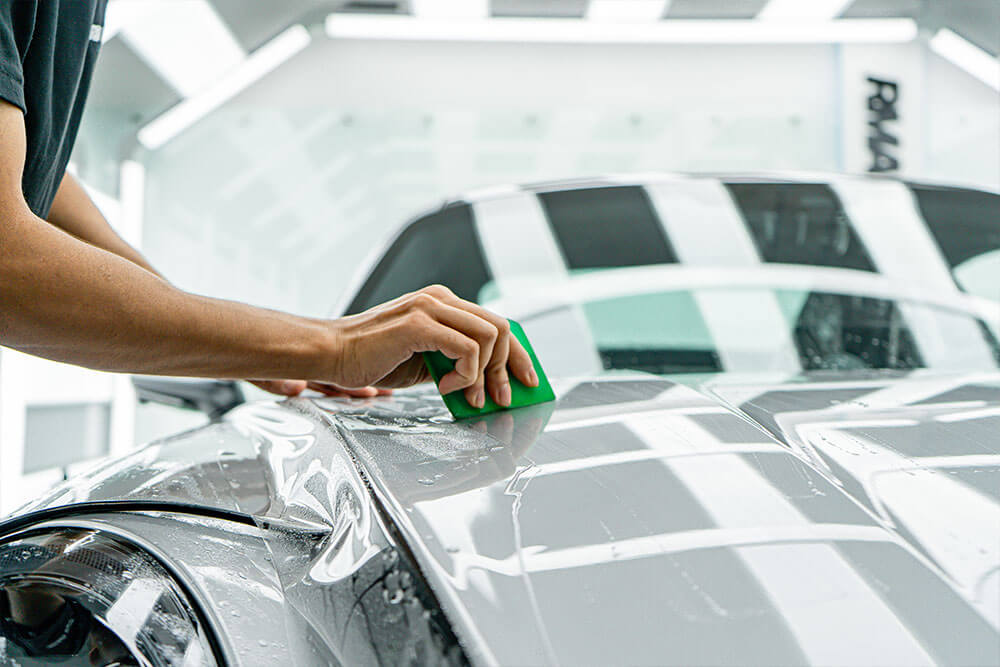
High-quality Paint Protection Film applications, like those using Profilm technology, provide an optically flat surface. Because the film is non-porous and “fills in” the microscopic valleys of the factory paint, the air travels more efficiently over the panels. In the world of EVs, reducing even a fraction of drag can translate into extra kilometers of range over long highway stretches like the E11.
2. The Self-Cleaning Effect and Airflow
In the UAE, a car can be covered in a fine layer of silt within hours. This “dust-clogging” increases the skin friction of the vehicle. Modern PPF coating technologies are infused with hydrophobic properties that reject dust and moisture.
By keeping the surface cleaner for longer, the PPF car maintains its intended aerodynamic profile. When air hits a clean, slick surface, it stays “attached” to the car longer before becoming turbulent. This is critical for EVs, which rely on clean airflow to the rear spoilers and diffusers to maintain stability and efficiency.
3. Protecting the “Aero-Fascia”
EVs often feature large, flat front “shields” instead of traditional grilles. While great for aerodynamics, these panels are “stone-chip magnets.” A single deep chip or a cluster of “pockmarks” creates localized air turbulence.
By applying a high-grade car paint protection, you ensure the leading edges of the vehicle remain perfectly smooth. Unlike factory paint which chips and craters, the best PPF absorbs the impact and self-heals, preserving the “factory-fresh” aerodynamic signature of the car’s nose.
4. Thermal Management and the “Cool” Factor
White and light-colored EVs are popular in Dubai for a reason: they reflect heat. However, when paint becomes oxidized or pitted, its thermal reflectivity decreases.
A premium Aliphatic TPU film contains UV inhibitors that prevent the paint from dulling. By maintaining the high-gloss, reflective nature of the surface, the film helps keep the cabin slightly cooler by reflecting more solar energy. This reduces the load on the HVAC system—one of the biggest “vampire” drains on an EV battery—thereby indirectly optimizing your driving range.
5. Why Precision Installation Matters for EVs
Aerodynamics are easily ruined by poor fitment. If a film has “lifted edges” or thick, visible seams, it creates “drag points.” At RMA PPF, we specialize in seamless edge-tucking. By ensuring the PPF on car panels is wrapped around the corners, we eliminate the ridges that catch the wind, ensuring your EV remains the silent, efficient machine it was born to be.
Conclusion: A Strategic Advantage for the Modern Driver
Choosing the best PPF in Dubai is no longer just about preventing a trip to the body shop. For the EV enthusiast, it is about maintaining the peak performance of a high-tech machine. Smooth-surface PPF ensures that your car’s drag coefficient remains as low as the day it left the wind tunnel, protecting both your paint and your range.

Get In Touch
Stay Connected For Ultimate Car Care
 sales@rmappf.ae