

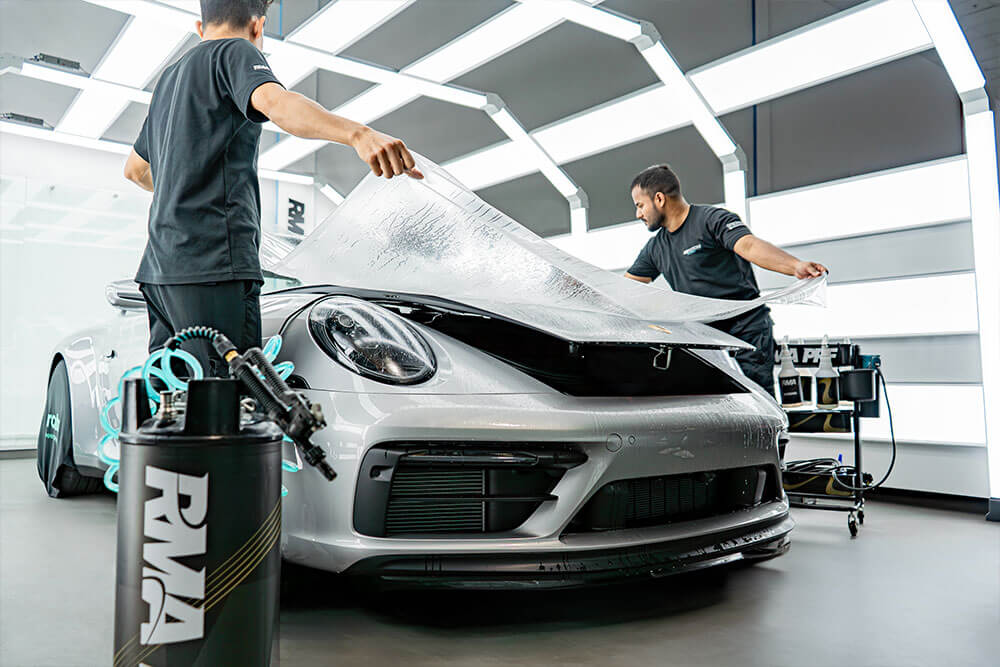
You’ve just taken delivery of a 700-horsepower masterpiece. The paint is a custom multi-stage pearl, the lines are aerodynamic perfection, and the PPF (Paint Protection Film) has just been squeegeed into place. You’re ready to hit the canyon roads.
But your installer says the words every supercar owner hates to hear: “It needs to sit for 48 hours.“
It feels like an unnecessary delay, but in the world of high-end detailing, the “Curing Phase” is the difference between a lifetime of protection and a premature failure. Here is why your supercar isn’t actually “finished” until the film has fully bonded.
1. The Chemistry of the “Slip Solution”
PPF is applied using a slip solution—a mixture of water and a specialized lubricant that allows the installer to slide the film into the perfect position. Even after the most meticulous squeegee work, a microscopic layer of moisture remains trapped between the adhesive and the clear coat.
Until that moisture evaporates, the adhesive hasn’t truly “grabbed” the paint. Driving at high speeds or in the rain during this window can cause the film to shift, creating “fingers” (lifting edges) that are nearly impossible to lay back down once dirt gets underneath.
2. The Danger of “High-Speed Wind Shear”
Supercars are designed to move air—fast. If you take a fresh install onto the highway at 80+ MPH, the wind pressure acts like a giant wedge. Because the edges (especially on wrapped-over panels) aren’t fully cured and hardened, the airflow can catch an edge and pull it back.
A “tucked” edge is a signature of a professional install, but that tuck only becomes permanent once the adhesive has undergone its final cross-linking phase.
3. Surface Tension and “Water Blisters”
In the first 24 to 72 hours, you might notice tiny, cloudy bubbles. This is normal—it’s the remaining slip solution gassing out through the porous structure of the urethane film.
If you leave the car in a controlled environment (or under specific heat lamps), these dissipate naturally. If you take the car out into freezing temperatures or direct, scorching midday sun too early, the rapid expansion or contraction of that moisture can cause permanent “water blisters” that mar the finish.
4. The Self-Healing Top Coat Needs Stability
Most premium PPF features a “self-healing” top coat that reacts to heat to swirl-proof itself. For this technology to work correctly, the underlying structure of the film must be stable. If the film is still “floating” on a layer of moisture, its ability to reflect light perfectly is compromised. Curing ensures the film lies as flat as possible, achieving that “invisible” look that makes people ask, “Is there even film on this?”
5. The Final “Check-Over”
At a professional studio, the curing period isn’t just about waiting—it’s about auditing. After 24 hours, an installer will do a “final pass.” They look for:
- Edge Lift: Tucking back any areas where the film didn’t initially hold.
- Relief Cuts: Ensuring tension hasn’t caused the film to pull away from complex curves.
- Trimming: Making micro-adjustments to ensure the film doesn’t interfere with sensors or trim pieces.
The Bottom Line
A supercar is an emotional purchase, and the desire to drive it immediately is powerful. However, PPF is a chemical bond, not a sticker. By respecting the curing window, you ensure that the “shield” you paid thousands for remains invisible and indestructible for years to come.

Get In Touch
Stay Connected For Ultimate Car Care
 sales@rmappf.ae