

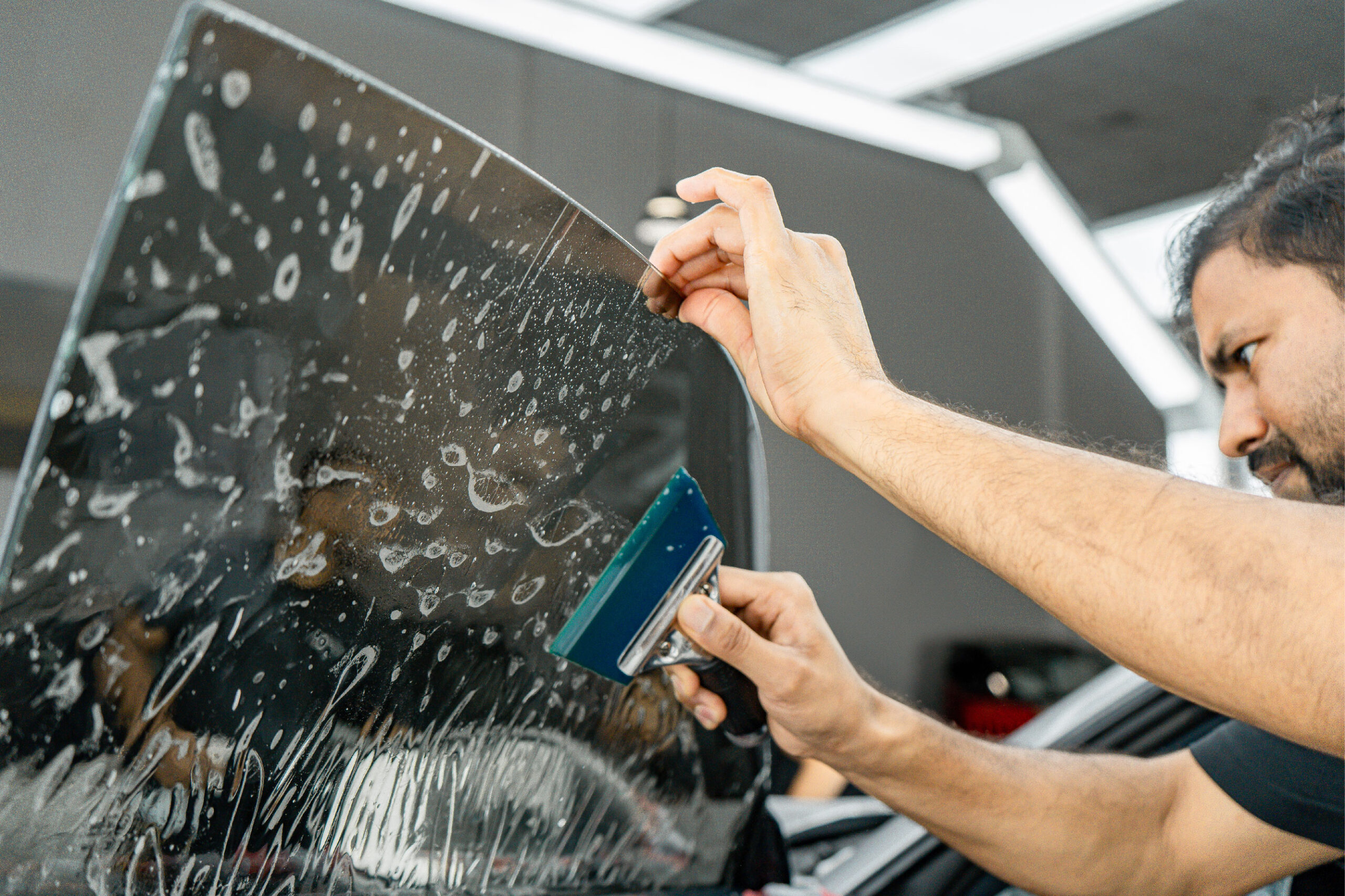
Many modern luxury vehicles and performance cars are equipped with a Head-Up Display (HUD), which projects critical data like speed and navigation onto the windshield. When owners consider window tinting for their front glass to combat the UAE heat, they often worry about one thing: Will it ruin the display?
At RMA PPF, we approach front-glass protection with a “forensic” focus on optical geometry. Here is how a car protection film interacts with your HUD and why the right installation is vital for your safety.
1. The “Ghosting” Effect
A windshield is not just a single piece of glass; it is a “laminated” sandwich of two glass layers with a plastic interlayer. Your HUD is specifically calibrated to project onto these layers at a precise angle to prevent “double imaging.”
- The Conflict: If you install a low-quality, thick, or poorly manufactured window tinting film, it can add an unplanned refractive layer. This causes the light from the HUD projector to bounce between the film and the glass, creating a “ghost” image that looks blurry or out of focus.
- The Solution: Premium nano-ceramic films are engineered for high optical clarity. By using a film with a consistent, ultra-thin profile, you maintain the sharp, singular image the manufacturer intended.
2. Polarization and the “Blackout” Trap
If you’ve ever worn polarized sunglasses while driving, you’ve likely noticed the HUD disappears or becomes incredibly dim. This is because HUDs use polarized light to create the image.
- The Science: Some metallic or older-generation car protection films have polarizing properties. If the polarization of the tint clashes with the polarization of the HUD projector, it can “cancel out” the light, making your display invisible.
- The RMA Choice: We exclusively use non-conductive, non-polarized ceramic films for windshields. These allow 100% of the HUD’s light waves to pass through, ensuring your speed and alerts remain vivid even in high-noon sun.
3. Heat Management for the Projector
The HUD projector is located deep in the dashboard, often under a small glass cover. This area is a “heat trap.” Intense solar energy passing through an untinted windshield can cause the HUD unit to overheat, leading to pixel degradation or “burn-in.”
- The Benefit: A high-IR rejection window tinting film actually protects the HUD hardware. By reducing the ambient temperature of the dashboard, you ensure the sensitive electronics and mirrors inside the projector don’t warp or fail over time.
4. Color Shift and Clarity
Budget tints often have a slight blue, green, or yellow hue. When your HUD projects white or red text, this “tint” can shift the colors of your navigation or speed alerts, making them harder to read at a glance.
The RMA PPF Standard
At RMA PPF, we understand that your windshield is your most important “screen.” Our technicians are trained to identify the specific projection angles of your vehicle’s HUD. We recommend nearly clear, high-definition ceramic films that provide maximum heat rejection without compromising a single pixel of your display.


Get In Touch
Stay Connected For Ultimate Car Care
 sales@rmappf.ae